

Press Release 15/ 2007 (88)
The 88 Generation Students
August 8, 2007
Rangoon (Yangon), Burma (Myanmar)
The 88 Generation Students' Announcement
on the 19
th
Year Anniversary of the 8888 Democracy Uprising
(1) Today is the 19
th
year anniversary of the 1988 popular democracy uprising in Burma, which is
remembered to this day as a great event not only in the history of Burma, but also of the world.
(2) We should learn from the lessons of this history. We need to learn and review logically and
without prejudice about the immediate and accumulated causes that forced the uprising to be
born.
(3) Thousands of peaceful democracy activists, including students, monks and peoples from all
walks of life, were killed or injured during the 8888 uprising. Thousands of families were brutally
broken by the tragedies as family members were taken to prisons, fled to the borders to live in
exile or were killed.
(4) A State Constitution is key to shaping the political, economic and social life of the country.
The 1974 Constitution, which cemented the single-party dictatorship and its closed-door
economic policy, was created by the previous dictator Ne Win, while politicians who held
different opinions were put in prisons.
(5) This was the reason why Burma, a country with the most potential to be developed among the
Southeast Asian nations and other newly-independent countries, became the poorest one.
(6) By making it extremely difficult to amend, the 1974 Constitution did not have enough
flexibility to timely solve the political, economic and social problems that led to a general crisis.
(7) Both, those who govern and who are governed, had to suffer the consequences as a result of
having a Constitution which was drawn by force and intentionally designed to be difficult to
amend.
(8) Therefore, the military government had recognized the demands of the people of Burma, who
led the 1988 popular democracy uprising. It had promised to implement a multi-party democratic
system and market economy when it came to power.
(9) History does not want us to move backward, but to move forward step by step. Today citizens
of Burma are the best witnesses of this history. They can compare the situations in 1962 when
General Ne Win staged a military coup and in 1974 when a single-party dictatorship emerged
from the Constitution.
(10) The 8888 popular democracy uprising in Burma was born because of the peoples'
unhappiness with the 1974 Constitution. It is true that another uprising in Burma today depends
entirely on current constitution drafting process.
(11) Therefore, we, the 88 Generation Students, would like to attest that preventing the negative
consequences of another disempowered and detrimental State Constitution will be the duty of all
people of Burma.
The 88 Generation Students
Rangoon, Burma
Monday, August 6, 2007
The 88 Generation Students' Announcement
Friday, August 3, 2007
Aung San Suu Kyi
Aung San Suu Kyi
Lintner, Bertil; Outrage:Burma's Struggle for Democracy, White Lotus, 1990.
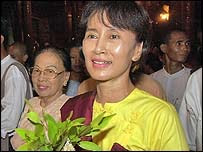
Aung San Suu Kyi, a Noble Peace Laureate of 1991, was cited by the Nobel Committee as "one of the most extraordinary examples of civil courage in Asia in recent decades." She was educated at Delhi University and Oxford University. She has won numerous awards and honors in addition to the Nobel Peace Prize, most notably the Rafto Human Rights Prize and the Sakhorov Prize. She is the general secretary and leader of Burma's National League for Democracy and was placed under house arrest by the military junta in July of 1989 for her activities.
small image
Influenced by the legacy of her father, Aung San Suu Kyi began her public support of her country's struggle for democracy and human rights on August 26, 1988.
Aung San Suu Kyi traveled extensively throughout the country, giving hundreds of speeches often to crowds of thousands, in an attempt to unite the people and reinstill their courage in achieving their long-sought goal of freedom. She was loved and revered by the Burmese people in their's country's time of darkness.
In courageous defiance of the military edict forbidding gatherings of more than four, people turned out in mass to listen to Aung San Suu Kyi wherever she spoke.
As Aung San Suu Kyi gained in popularity, military harassment of her campaign esclated. Here, she is trailed by an armed government solider.
Shortly before her house arrest in July 1989, Aung San Suu Kyi spoke out on behalf of all the ethnic minorities and the principles of democracy.
Within a system which denies the existence of basic human rights, fear tends to be the order of the day...A most insidious form of fear is that which masquerades as common sense or even wisdom, condemning as foolish, reckless, insignficant, or futile the small, daily acts of courage which help to preserve man's self-respect and inherent human dignity.
-Aung San Suu Kyi
Aung San Suu Kyi wrote numerous essays in her Rangoon home during Burma's upheaval in the final months of 1988.
In May 1992, the SLORC allowed Dr. Miachael Aris, Aung San Suu Kyi's husband, and her two sons to visit her for the first time in almost three years.
While in detention, Aung San Suu Kyi was visited by her two sons, Alexander (left) and Kim (right) in May 1993.
Aung San Suu Kyi with her British husband, Michael Aris, in 1973.
Daw Aung San Su Kyi's independence day
Daw Aung San Su Kyi's independence day speech stresses faith in Burma’s youth
04 January 2003 (Mizzima News)
Today, on Burmese Independence Day, a ceremony was held at NLD headquarters in Yangon, featuring traditional singing and a dance party. In the morning, the Secretary- General of the NLD, Daw Aung San Su Kyi, attended the celebration as did other senior politicians. Daw Aung Su Kyi shared her good wishes for the Burmese people.
Daw Aung San Su Kyi extended her gratitude especially to the young people of Burma: “What I want to say to the people of Burma is that to protect the spirit of liberty is to protect something that is worthwhile, so no one will set it aside or throw it away on the street if it is so truly worthy. So liberty is not the thing that should be thrown away in the streets. Only if we are able to protect liberty will it be long lasting. That’s all! I also personally want to express my gratitude towards the young people. When I was on my trip, especially the young people welcomed me very warmly and supported me. I was very much encouraged by them, and I found a lot of hopes for the future of Burma. Therefore I want to thank the youth and encourage them to keep trying, and I would like to share my best wishes for the young people so that they may grow into people serving the country”.
Detention in Myanmar
In 1990, the military junta called a general election, which the National League for Democracy won decisively. Under normal circumstances, she would have assumed the office of Prime Minister.[4] Instead, the results were nullified, and the military refused to hand over power. This resulted in an international outcry and partly led to Aung San Suu Kyi's winning the Sakharov Prize that year and the Nobel Peace Prize the following year in 1991. Her sons Alexander and Kim accepted the Nobel Peace Prize on her behalf. Aung San Suu Kyi used the Nobel Peace Prize's 1.3 million USD prize money to establish a health and education trust for the Burmese people.
^ "Myanmar mercifully extends Suu Kyi detention", CNN.com, 2007-05-25. Retrieved on 2007-05-25.
^ http://mwcnews.net/content/view/14517&Itemid=1
^ http://www.narinjara.com/details.asp?id=1282
^ http://archive.gulfnews.com/articles/07/05/30/10128726.html
^ US urges Burmese to free Suu Kyi. BBC News (2004-12-02). Retrieved on 2006-05-22.
^ Overzicht Eredoctoraten Vrije Universiteit Brussel (Dutch). Vrije Univeriteit Brussel. Retrieved on 2006-07-04.
^ "Arrest Yourself", US Campaign for Burma. Retrieved on 2006-07-04.
^ "St. Hugh's Full Moon Ball", The Burma Campaign UK. Retrieved on 2006-07-04.
^ Burma Library website
^ Burma Lawyers' Council characterizes Declarations as Landmark
^ Bommersvik Declaration I in pdf from the National Coalition Government of the Union of Burma website
^ Bommersvik Declaration II in pdf from the National Coalition Government of the Union of Burma website
^ "for the lady", BBC Burmese, 2004-11-01. Retrieved on 2006-07-04.
^ Cowley, Jason. "Heroes of our time — the top 50", New Statesman, 2006-05-22. Retrieved on 2006-05-22.
Aung San Suu Kyi entered politics to work for democratisation,

Aung San Suu Kyi returned to Myanmar in 1988 to take care of her ailing mother. By coincidence, in that year, the long-time leader of the socialist ruling party, General Ne Win, stepped down, leading to mass demonstrations for democratisation on August 8, 1988 (8-8-88, a day seen as favorable), which were violently suppressed. A new military junta took power.
Heavily influenced by Mahatma Gandhi's philosophy of non-violence[2][3] , Aung San Suu Kyi entered politics to work for democratisation, helped found the National League for Democracy on 27 September 1988, and was put under house arrest on 20 July 1989. She was offered freedom if she would leave the country, but she refused.
One of her most famous speeches is the "Freedom From Fear" speech, which begins:
“ It is not power that corrupts but fear. Fear of losing power corrupts those who wield it and fear of the scourge of power corrupts those who are subject to it.


![ko aung san[1].sutdent"s union](http://4.bp.blogspot.com/_a0nfpjJrE5M/RsqTYaF216I/AAAAAAAAAIY/SxCMvs6FM5U/S228/ko+aung+san%5B1%5D.sutdent%27s+union+chair.jpg)



.jpg)


